
Review: The Suppressed Ruger-5.7 Pistol
Back in 2020, I wrote a guest post for the Women’s Outdoor News about the then-new Ruger-5.7 pistol – I’ll repeat some of the relevant information in this blog posting – and I liked the gun enough that I bought it. A year later I replaced gun’s original barrel with a Ruger factory threaded barrel kit so that I could shoot the gun suppressed. Because of the recent interest in the Twin Falls, Idaho, murder of three people at a fast-food restaurant, and the use of a suppressed 5.7 x 28 mm handgun by an armed bystander to help repel the murderer before he topped himself, I decided to update my original writing with a bit of information regarding suppressing and shooting the Ruger-5.7. When I run out of factory loads, I’ll likely start reloading the cartridges (future blog posting?).
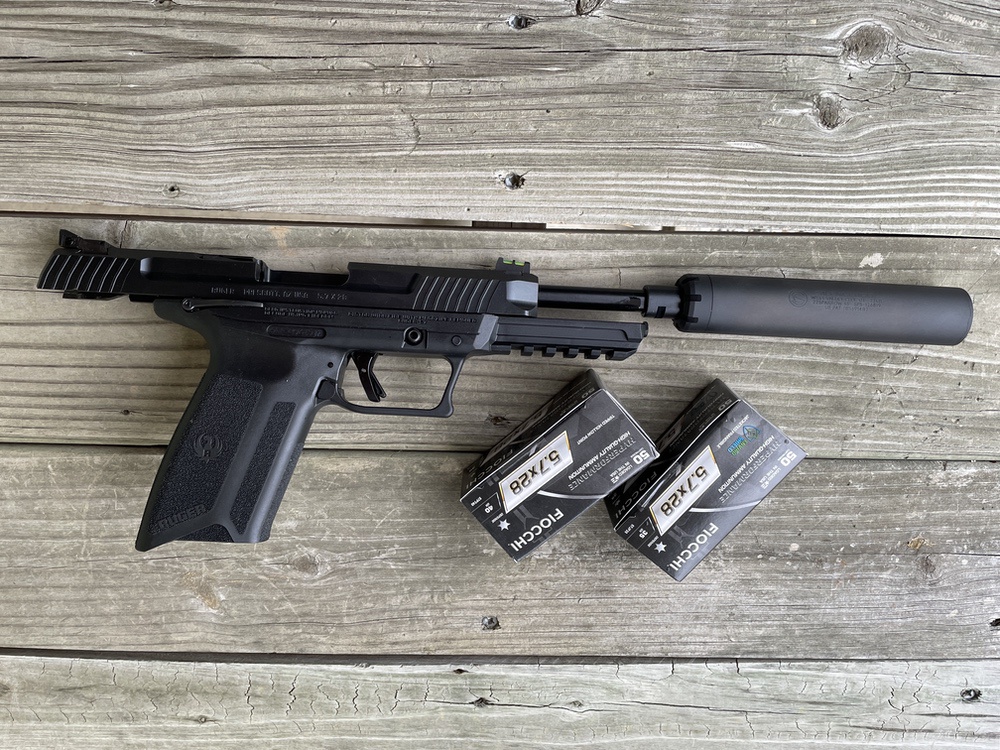
Ruger-57 on bench with ammo and silencer
Why the 5.7 mm cartridge? The NATO quest for new “Personal Defence Weapons”
In the late 1980’s, just prior to the dissolution of the Soviet Union in 1991, the Soviet and Warsaw Pact militaries continued their struggles to maintain an imagined superiority over NATO military forces. As a part of this effort, the Soviets developed and fielded a new body armor system that was designed to prevent penetration by the NATO-standard pistol and submachine gun ammunition, the 9 x 19mm Parabellum (“9mm Luger” ammunition). In response, in the early 1990’s a planning group within NATO created the “Program for Collaborative Research Into Small Arms Technology,” commonly known by its acronym, CRISAT. One of the CRISAT research areas was to standardize a dismounted personnel target wearing body armor and head protection analogous to the current Soviet/Warsaw Pact design. Per the usual NATO practice, they categorized the document describing this target as a Standardization Agreement, or STANAG, number 4512. The STANAG 4512-defined body armor had a hardened 1.6 mm titanium strike plate backed by 20 layers of Kevlar and it could stop the 9mm Luger projectile.
The Search for a PDW
Because of the supposed ability of the late-era Soviet-style body armor to degrade the effectiveness of the 9mm ammunition used in the primary weapons carried by support troops (truck drivers, artillery crews, etc.), NATO began a search for new so-called Personal Defence Weapons (note the Brit spelling of defense), or PDWs, employing ammunition more effective at defeating the CRISAT STANAG 4512 body armor. Such ammo would allow support troops to utilize more effective handguns, and to have shoulder-fired arms that were lighter and shorter than assault rifles and more controllable in full auto fire than submachine guns.
R&D by major European arms manufacturers into new ammo that met the NATO PDW concept, as well as handguns and long guns to chamber the ammo, resulted in two primary contenders – the HK MP-7 firing Heckler & Koch’s new 4.6 x 30mm cartridge, and the FN P90 and Five-seveN weapons firing Fabrique Nationale Herstal’s new 5.7 x 28mm cartridge. Both cartridges are bottlenecked, rimless or rebated rim centerfire designs that fire smaller caliber bullets at higher velocities than 9mm NATO handguns and submachine guns.
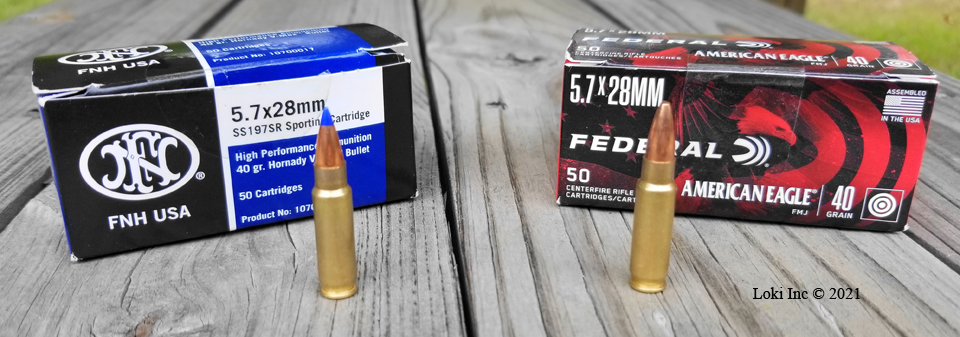
FNH 40 gr VMax and Federal 40 gr FMJ
For several reasons, the FN designs were favored by NATO evaluators (except for the German delegation, apparently because HK is a German company) but NATO’s failure to agree on standardization of a NATO PDW, as well as the collapse of the Soviet Union halted the process indefinitely.
Nevertheless, more than 50 national governments and many other smaller governmental organizations have selected PDWs of one sort or the other to arm Special Forces, police, military support troops, and personal protection units so the concept is active even if NATO has not officially standardized a PDW or its ammunition.
Cue the Ruger-5.7
It is 30+ years since the beginning of the PDW business, and the 5.7mm caliber is now gaining some attention in the US, apparently due in no small part to Ruger’s introduction of an autoloading handgun, the Ruger-5.7, more than five years ago. To recap, the gun has a magazine capacity of 20 rounds, an internal hammer and is recoil-operated through use of a delayed blowback functional design. As opposed to blowback designs where the barrel is fixed to the gun frame, in the Ruger system a recoil spring holds the barrel and slide together until right after the gun is fired. At that point, the barrel and slide travel rearward at different speeds until a cutout in the barrel underlug strikes a stop. The slide continues its rearward movement, extracting and ejecting the spent cartridge case, cocking the hammer, and further compressing the recoil spring. When the slide reaches the end of its travel, the recoil spring forces it to travel forward whereupon it strips the top round from the magazine and chambers it. The slide and barrel continue to move forward into their firing positions.
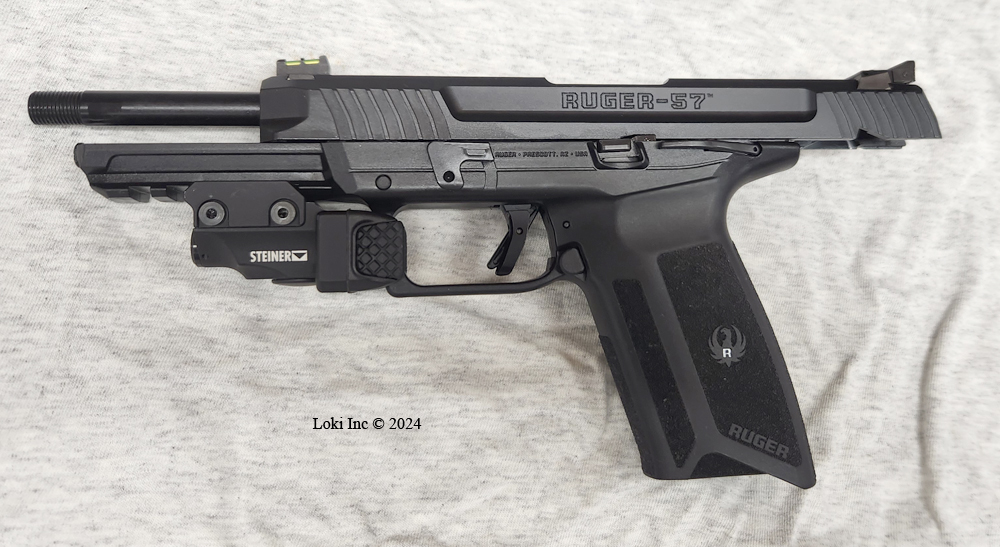
Ruger 57 glam shot
Ruger Secure Action
Ruger’s Secure Action fire control, which is very similar to the LCP II and Security-9 systems, uses a transfer bar from the trigger to the internal hammer’s sear to provide a double-action system. As such, the trigger pull feels nearly the same whether you are firing the first round from the magazine or the last. My pistol’s trigger has a long take-up that disengages the trigger safety (the little bar in the middle of the trigger paddle) before presenting resistance to the shooter’s trigger finger. At that point, the trigger stages to about a 4-1/2 pound pull and fires. At first, that stage felt inconsistent to me from one shot to the next, but after initially checking-over and cleaning the gun, firing nearly 100 rounds, and then thoroughly cleaning it again with special attention to the trigger group, hammer, and hammer sear, the trigger felt the same from one pull to the next.
Pistol Safety, Slide Stop, Magazine Release
My pistol also has a bilateral manual safety at the rear of the slide, which operates in the same manner as one on a 1911-style gun – rotated up is safe, and rotated down to the horizontal is the fire position. This safety locks the trigger transfer bar, and it prevents the slide from moving, so with the safety on, the trigger will not operate and the slide cannot be retracted. In addition, a hammer catch prevents the hammer hitting the firing pin unless the trigger is pulled.
The slide stop and magazine release are located in positions that will be familiar to many handgun shooters – the stop is on the left side top of the frame and accessible to the right thumb when using a right-handed grip, and the release is at the base of the trigger guard on the left side of the frame. The magazine release can be relocated to the right side of the frame if the shooter desires.
Threaded Barrel Kit
The threaded barrel kit comes with a replacement barrel with threaded muzzle, adapter, thread protector and wrench. The adapter is required for suppressors using ½ – 28 mounting threads, as the barrel has M10 threads as it comes from the factory, and the thread protector covers the adapter threads.
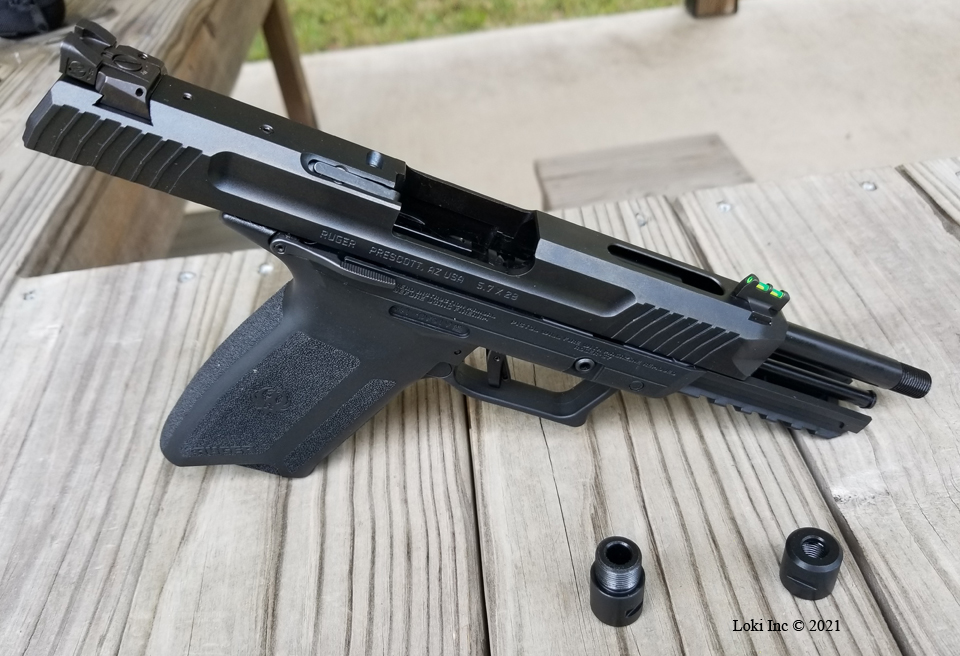
Ruger-5.7 w threaded bbl thread protector and suppressor adapter
My suppressors are both from SilencerCo – the Sparrow 22, and the Switchback 22, each rated for the 5.7 x 28mm round. No pistol booster device is necessary. Of course, if you use a suppressor, make sure it is rated for the caliber and use (Full auto? Not in this case) you’ll make of it, and that it is compatible with ½ x 28 threads. Even though it may fit on the adapter, and allow a .22 caliber bullet to pass through, do not use a suppressor that is not specifically rated by its manufacturer for the 5.7 x 28mm cartridge, as the 5.7 ammo has a much higher operating pressure and greater gas volume than a .22 rimfire cartridge.
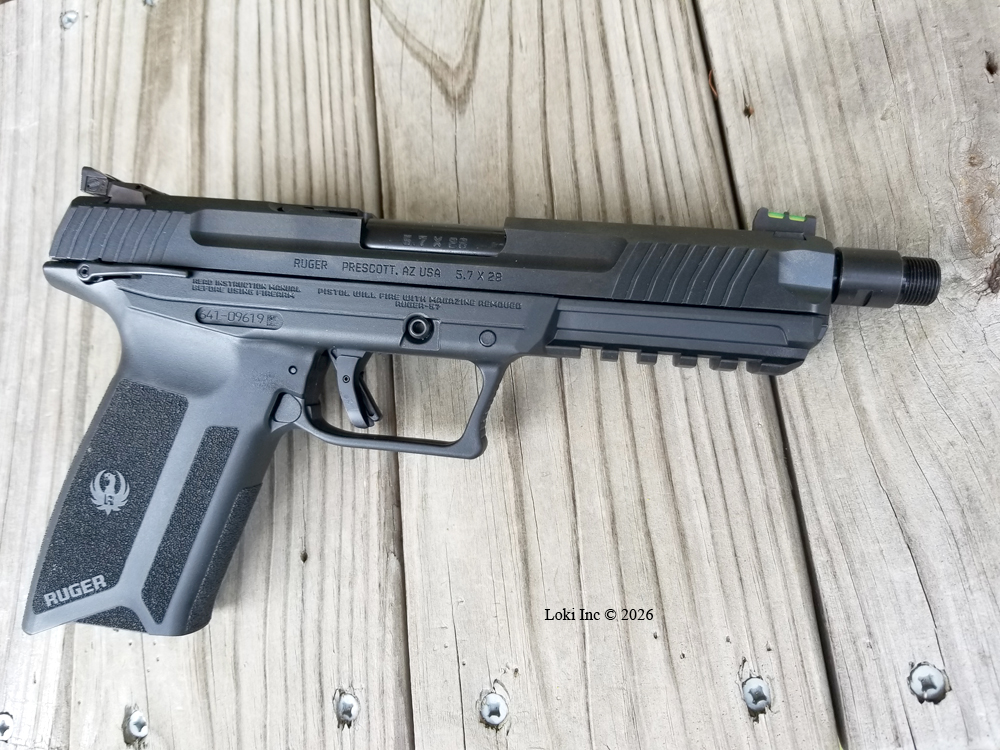
Ruger-5.7 w threaded bbl and suppressor adapter installed
Shooting the Ruger-5.7 with a Suppressor
Ruger recommends using 40-grain 5.7 x 28mm ammunition when using a suppressor, particularly if you have an optic mounted on the slide; otherwise, you may have occasional ammo feeding failures with the gun. Nevertheless, my wife and I decided to try a full line of factory ammo in the gun.
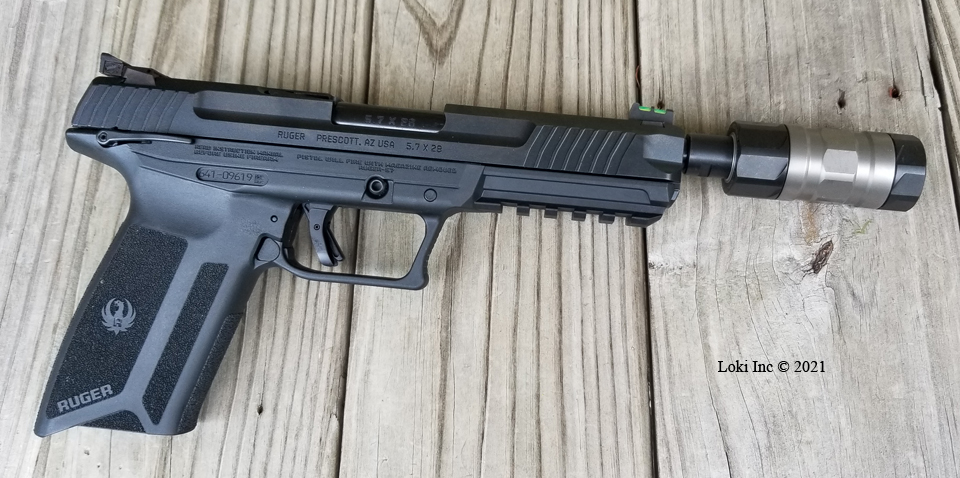
Ruger-5.7 with SilencerCo Switchback short version installed
From Fiocchi, we shot Range Dynamics 62 grain FMJ subsonic, Hyperformance 40 grain plastic tipped HP, and Hyperformance 35 grain jacketed frangible rounds. From Federal, we shot American Eagle 40 grain FMJ, and from FNH USA 40 grain ammo with Hornady V-max bullets.
We shot at targets from 7 to 40 yards downrange, and steel at 40 yards. We enjoyed the shoot, and none of the ammo shot very far from the original sight alignment. The Sparrow 22 didn’t affect the point of impact compared to how the gun shot without the suppressor. We used the factory iron sights, and nicely, the Sparrow was small enough that it was below the line of sight.
One caveat – be sure to clean the gun thoroughly. The 5.7 x 28mm ammo uses lacquered brass cases, and lacquer build-up in the barrel chamber and in the slide’s firing pin channel can cause stoppages.
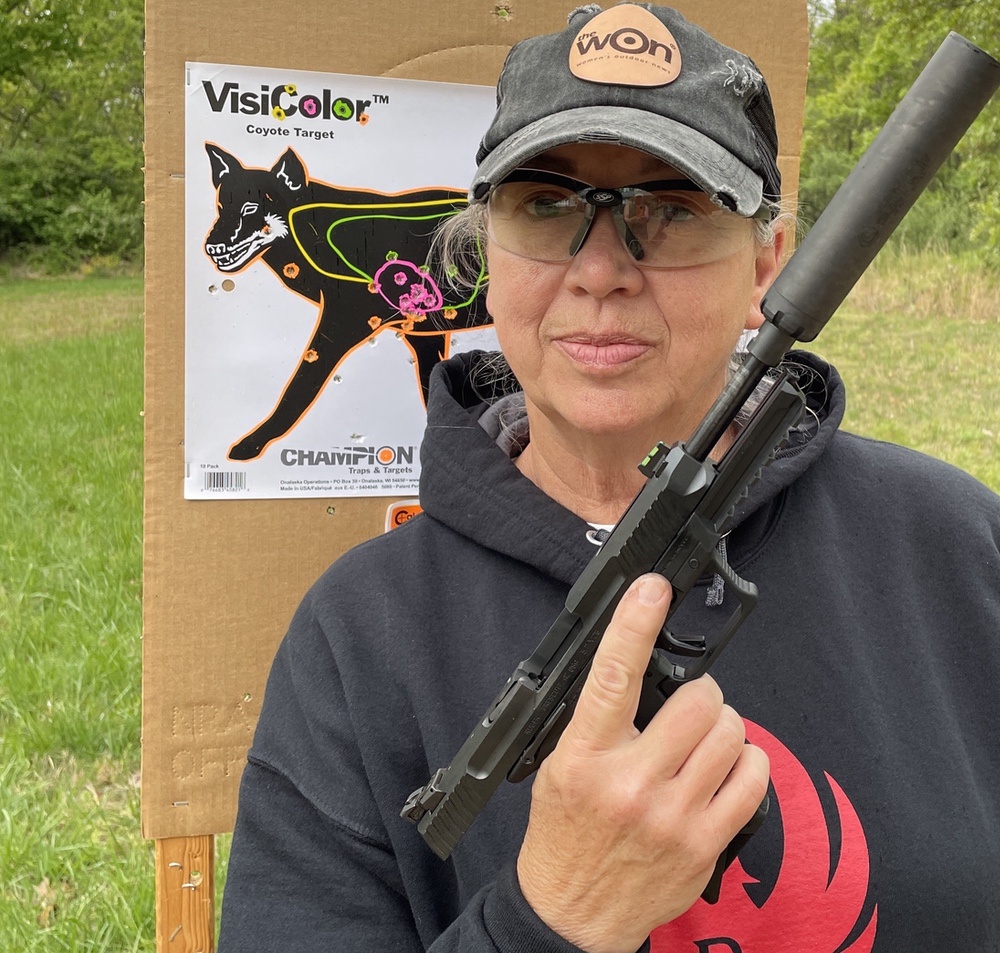
Barb with Ruger-57 and Sparrow 22
Resources:
Arvidsson, Per G., NATO Infantry Weapons Standardization (briefing), https://ndiastorage.blob.core.usgovcloudapi.net/ndia/2008/Intl/Arvidsson.pdf downloaded 7/6/2020
“In the line of fire,” Global Defence Review, https://web.archive.org/web/20061016074936/http://www.global-defence.com/2006/Utilities/article.php?id=40 downloaded 7/6/2020
Recent Posts
September 11, 2026Review: The Suppressed Ruger-5.7 Pistol
July 27, 2026 September 23, 2025.22 Caliber Suppressor Cleaning
August 20, 2025Trophy Hunting – Is it Ethical?
August 6, 2025